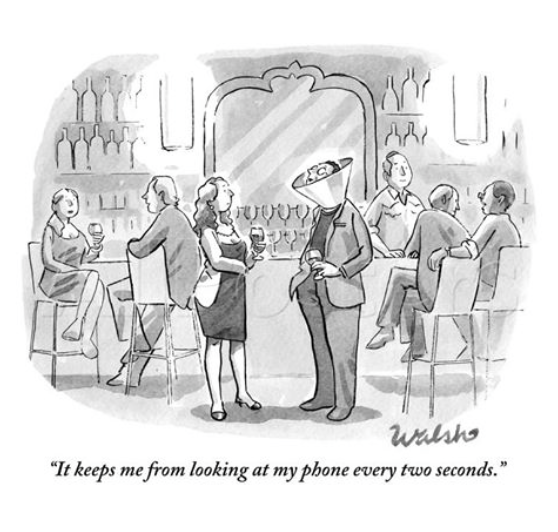
QUIT PHUBBING AROUND
DISCLAIMER
Coming from a technology background, I’m not immune from the social behavior that will be discussed in this article. In fact, I have exhibited many of these behaviors over the past eight years since the smartphone was born (the iPhone and the film “Ratatouille” were both introduced on June 29, 2007), so I can relate to the misuse and over use of technology in social situations. I have seen hundreds of new computers and devices come and go over the past 40 years, but none of them have created the technology pull that smartphones have in such a short period of time. So, what’s wrong with the smartphone? Nothing. Is it really smart? Yes, but sometimes we aren’t. The problem is not the smartphone. It is having the phone with us at all times when we really need to give each other our full attention.
THE ORIGIN OF PHUBBING
On May 22, 2012 at the University of Sydney, Australia, a group of language experts (a lexogologist, a phonetician, a debating champion, a poet, several authors and a cruciverbalist) gathered together to create a word that would get people to put their phones down and get talking to each other again. The word “phubbing”, which they created at 4:22 p.m. that day quickly spread throughout the world, attracting the attention of over 300 million people in over 180 countries. It began to prompt discussions about smartphone etiquette and the truth that so many of us are frustrated by the behavior caused by the proliferation and use of smartphones in social situations. Without a word or term to describe this social behavior, it had gone unchecked since the beginning of the smartphone era. This anti-phubbing campaign was intended to deliver the message that “phubbing is a social scourge and people of all ages, all nationalities and either sex, offend at some point.”
RECLAIMING CONVERSATION
In her new book, Reclaiming Conversation, the Power of Talk in a Digital Age, clinical and developmental psychologist Sherry Turkle, professor of social studies of science at MIT, examines how smartphones and social media have crowded out real conversation. She says, “human relationships are rich, messy, and demanding. When we clean them up with technology, we move from conversation to the efficiencies of mere connection.” Professor Turkle lists the three promises our smartphones make us, (1) we’ll never have to be alone, (2) we’ll always be heard, and (3) we can put our attention wherever we want to be so we’ll never have to be bored.”
Turkle goes on to explain the importance of conversation and the development of empathy. The valuable elements in face-to-face conversations are (1) you don’t edit yourself, (2) you are spontaneous, and (3) you let yourself be vulnerable. In face-to-face conversations, empathy is born, collaboration hardens and close connection happens
We have become so vulnerable to the seduction of who wants to reach us, that we turn away from our face-to-face conversations with family and friends in exchange for the neuro chemical hit of constant connection we receive from the next text message or event notification.
We increasingly miss out on the important moments of our lives as we look down at our iPhones, archiving our life through text messages, Facebook and SnapChat and shielding ourselves from the outside world with the false sense of connection our smartphones provide us.
SOCIAL IMPACT STATISTICS
87% of teens would rather communicate via text than face-to-face.
89% of adults in their last face-to-face interaction pulled out a smartphone, and
82% said that it deteriorated the quality of the conversation.
77% of smartphone users reported that they turn to their phone to avoid being bored
93% (18-29 year olds)
82% (30-49 year olds)
55% (50+ year olds)
58% of smartphone users don’t go one hour without checking their phones.
40% decline in empathy among college students in the last 20 years, most of it in the last 10 years
TECH CEO’S
When Nick Bilton of the New York Times was interviewing Steve Jobs in late 2010, he asked, “So, your kids must love the iPad?” and Jobs answered, “They haven’t used it. We limit how much technology our kids use at home.” Chris Anderson, the former editor of Wired magazine, has instituted time limits and parental controls on every device in his home because he has seen the dangers of technology firsthand (exposure to harmful content, bullying from other kids and becoming addicted to their devices). Evan Williams, a founder of Blogger, Twitter and Medium says that in lieu of iPads, his young boys have hundreds of books that they can pick up and read anytime. These tech CEO’s seem to know something that most of us don’t, and they all agree on this one universal rule: “There are on screens in the bedroom. Period. Ever.”
UNPLUGGING
Zachary First, senior managing director of the Drucker Institute, believes that there are tremendous benefits of unplugging from technology. In his April 8, 2015 article in the Harvard Business Review, he states that “a growing body of neuroscience research reveals the exact ways in which technologies cut against the natural grain of the human mind. Our understanding of all kinds of information is shaped by our physical interaction with that information. When you move from paper to screen, your brain loses valuable topographical markers for memory and insight. In short, when you want to improve how well you remember, understand and make sense of crucial information, sometimes it’s best to put down the tablet and pick up a pencil.”
If you are so inclined to participate, the National Day of Unplugging, a project of Reboot, takes place on the first Friday of the month, and this year will begin on March 4th.
TECHNOLOGY SHABBATS
Tiffany Shlain, the founder of the Webby Awards and acclaimed filmmaker from Marin County, believes that technology is clearly changing us and the way we connect with our friends and families and the world around us. So once a week from Friday sundown to Saturday sundown, she and her family take a “Technology Shabbat” and unplug from all of their technology. Shlain says that “unplugging for a day makes time slow down and makes me feel more present with my family. We try to be as unavailable as possible, except to each other and our children.
I not only appreciate this quality time with them, but it has also made me appreciate technology in a whole new way. By sundown on Saturday, we can’t wait to get back online. Still, every week we remember the most important thing about technology: It has an off switch.”
NOMOPHOBIA (No Mobile Phone Phobia)
There is a new phobia centered around our relationship with the smartphone. This phobia occurs in situations when an individual experiences anxiety which is due to the fear of not having access to a mobile phone. This anxiety is provoked by several occurrences, such as the loss of a phone, loss of reception or a dead smartphone battery. If you experience this phobia during a technology shabbat, you may want to cut out early Saturday morning before anxiety overtakes you.
CONCLUSION
Is there a cure for the failing connections of this digital world? Yes, and we can start by:
•Taking and experiencing regular (weekly) technology time-outs.
•Designating sacred areas in our home (kitchen, dining room, bedrooms) and car and keeping them phone-free.
•Talking to each other, uninterrupted by technology or the threat of technology.